

What Does Off Page SEO Include ? (TACTICS TO TRY)

Off-page SEO includes efforts made outside of your website to boost its search engine rankings. Typical off-page SEO practices include generating backlinks, promoting branded searches, and improving social media engagement and shares. In other words, off-page SEO includes all activities conducted off your site to help Google and other search engines recognize your website as reliable and authoritative.
If you’re ready, I’m going to guide you through everything you need to know about off-page search optimization.
Understanding Off Page SEO
Off-page SEO involves strategies and tactics used outside of your website to impact your rankings within search engine results pages (SERPs). Unlike your knowledge of what does on-page SEO includes, which mainly focuses on optimizing elements on your own site, off-page optimization revolves around boosting your site’s perception through external means.
What does Off Page SEO Include?
Off-page optimization is a critical aspect of search engine optimization (SEO) that focuses on improving a website’s presence and authority through means outside its own domain. Here are some key elements that off-page optimization typically includes:
- Link Building: The cornerstone of off-page SEO. This involves getting other reputable websites to link back to your site. High-quality backlinks from authoritative sites can significantly boost your site’s ranking.
- Social Media Marketing: Utilizing social media platforms to promote content and engage with audiences. This doesn’t directly influence rankings but can drive traffic and enhance online visibility.
- Influencer Outreach: Collaborating with influencers to promote your brand or content. This can lead to natural link building and increased exposure.
- Guest Blogging: Writing content for other websites. This can help in building relationships with peers and influencers, leading to quality backlinks.
- Local SEO: For businesses with a physical location, local SEO is crucial. This includes optimizing your Google My Business listing and getting listed in local directories.
- Brand Mentions: Unlinked mentions of your brand can also contribute to your site’s authority. Google understands and values the context in which your brand is discussed.
- Forum Participation: Engaging in industry forums and discussion boards. This helps in establishing authority and can lead to direct traffic and potential backlinks.
- Content Marketing: Creating and promoting high-quality, valuable content that others want to reference and link to.
- Online Reputation Management: Monitoring and influencing how your business is perceived online.
- PR and Media Coverage: Getting featured in media publications can boost your website’s visibility and credibility.
Remember, when researching and understanding what are the types of SEO, off-page SEO emerges as a key component that goes beyond simply creating links. It entails maintaining a positive brand perception, cultivating meaningful relationships, and creating a highly valued online presence among both users and search engines. In the sections that follow, we will go into greater detail about the many aspects of off-page SEO.

Why Is Off-Page SEO Important?
Think of off-page SEO as reputation management for your website. It involves activities like building quality backlinks, encouraging branded searches, and increasing social media engagement. These actions signal to search engines that your site is reputable and trustworthy, leading to higher visibility in search results. Backlinks from authoritative websites act as votes of confidence, validating your content’s quality and reliability.
Another crucial aspect is focusing on Experience, Expertise, Authoritativeness, and Trustworthiness (E-E-A-T), a concept used by Google’s Quality Raters. By earning mentions and links from reputable sources, you enhance your E-E-A-T score, which positively impacts your rankings. In short, off-page SEO significantly influences your site’s ranking by building credibility and trust with search engines, boosting your visibility, and attracting more visitors. Investing in off-page SEO is essential for the overall health and reputation of your website.
On-Page SEO vs Off-Page SEO
Understanding the distinction between on-page and off-page SEO is crucial for developing a well-rounded SEO strategy. Both are essential in boosting your website’s visibility and search engine ranking.
| Aspect | On-Page SEO | Off-Page SEO |
|---|---|---|
| Focus | Website content and structure | External signals and links |
| Key Elements | Meta tags, keywords, internal linking, content | Backlinks, social media, brand mentions |
| Goal | Improve user experience and search relevance | Enhance site credibility and authority |
| Control | Direct control over website elements | Indirect control, relies on external factors |
| Examples | Title tags, meta descriptions, header tags | Guest blogging, influencer outreach, social shares |
| Impact | Immediate effect on website performance | Long-term influence on site reputation |
| Maintenance | Regular updates and content optimization | Ongoing relationship building and engagement |
Both on-page and off-page SEO are integral to a successful SEO strategy. By effectively balancing both, you can achieve higher search engine rankings and increased traffic to your site.
4 Off-Page Techniques that impacts
Let’s explore four distinct off-page strategies that can improve your site’s authority and increase organic search traffic.
1. Backlinks
Arguably the most significant off-page SEO factor are backlinks. Search engines like Google view backlinks as votes of confidence. The more high-quality backlinks your site has, the more reputable it appears, which can positively influence your rankings.
However, not all links are created equally. Some will move the needle significantly, while others will move it slightly or not at all
Here are some tips to attract more backlinks :
- Quality over Quantity: Aim for links from reputable sites related to your niche.
- Diverse Link Profile: Variety in link types and sources can enhance your profile.
- Competitor link building: Find and imitate your competitors’ top links.
- Guest posts: Write a post for another website in exchange for a link.
- Linking between resource pages: Submit your work to pages that curate industry resources.
2. Social Signals and Online Presence
Social signals and SEO is a relationship that gathers two efforts, which means your presence on social media platforms can indirectly impact your SEO efforts. While social shares are not a direct ranking factor, they increase visibility and traffic to your site, which search engines consider.
Even if you don’t obtain a link or immediate traffic, you will receive more attention. Increased attention leads to more branded searches and mentions.
- Build a strong social media presence to support your SEO efforts.
- Foster community engagement to amplify content reach and trick the algorithm
3. Local SEO and Citations
Local SEO and citations and directory listings reinforce your business’s existence and location, contributing to local search rankings. and mainly there are two off-page techniques you should use as a local business :
1. Google Business Profile Management
Google Business Profile (GBP) is a free tool that allows you to manage how your business appears on Google. Since this takes place outside of your website, optimizing your Google Business Profile is an essential off-page SEO strategy. It’s actually a vital factor in local SEO rankings.
By optimizing Google Business Profile, you can boost your site’s visibility in prime spots on Google’s search results pages, such as the map pack for searches like “workspace in Toronto.”
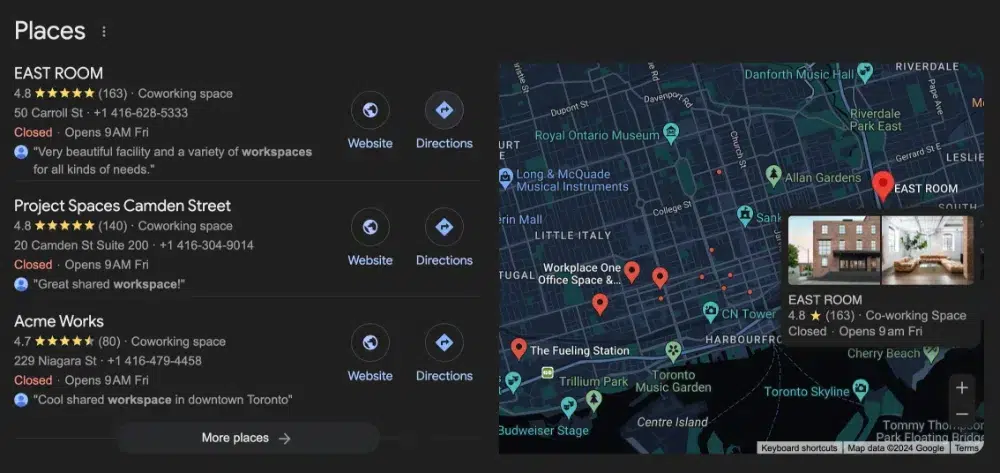
Here are some Google Business Profile Tips:
- Be cautious with your contact information.
- Respond to every review.
- Publish posts regularly (including photographs and videos).
- Be as specific as you can with your business category
- Add your business working hours
- Add your address
- Set your service area
- Add your products/services
2. NAP SEO
NAP SEO stands for Name, Address, and Phone Number Search Engine Optimization. It is a crucial aspect of local SEO that focuses on ensuring your business’s contact information is consistent and accurate across the web. Proper NAP management can significantly improve your local search rankings and build trust with both search engines and potential customers.
Keep in mind that NAP citations are significant since Google uses them to ensure that all of your business information is correct.
Why Local SEO Matters
- Visibility: Local SEO increases your visibility to potential customers in your area.
- Relevance: It tailors your online presence for a specific region or locality, enhancing relevance.
- Competition: It helps you stand out among local competitors in your niche.
4. Brand Mentions and Reputation
Unlinked brand mentions are online references to your brand name that don’t include a link for example “Organix Media” rather than “Organix Media”).
Unlinked mentions of your brand can also contribute to off-page SEO. Search engines are increasingly recognizing these implicit endorsements.
- Monitor brand mentions and manage your online reputation carefully.
- Engage with your audience and industry influencers to increase brand visibility.
In sum, an effective SEO strategy balances on-page and off-page factors. Your efforts in building a strong external presence can significantly improve your optimization and ability to rank in SERPs. Remember, the goal is to enhance both your site’s authority and appeal to both search engines and users.
Need a Digital Solution?
Get in contact now with Experts!
We answer calls 24/7!
The Role of Link Building
Link building is a crucial component of off-page SEO, involving the acquisition of high-quality backlinks from reputable websites to improve your site’s authority and visibility. Off-page SEO includes various strategies, but link building is one of the most effective for improving search engine rankings and driving organic traffic.
Types of Links
There are primarily two types of links relevant to your SEO efforts: DoFollow and NoFollow. DoFollow links are the most valuable for SEO as they pass on link equity, contributing to your site’s authority. NoFollow links do not pass on authority but are still essential for a natural link profile.
Link Building Strategies
Link building is the process of gaining links from other websites to your own. Backlinks are a phrase used in SEO for this process. A website or domain with many backlinks may appear to be more trustworthy to Google.
Semrush can determine you website authority using a term called Authority Score, which takes into account the quality and number of backlinks, levels of organic traffic, and the general naturalness of the site’s backlink profile.
Remember to prioritize the quality of links over quantity to boost your domain authority.
In order, the other most important off-page SEO metrics are:
- Page Authority Score
- Number of referring IPs (domain)
- Number of referring domains (domain)
- Number of referring IPs (URL)
- Number of referring domains (URL)
- Number of backlinks (domain)
- Number of backlinks (URL)
To get the data of your site, you can consider Semrush backlinks tool by just entering your domain as in the screenshot below
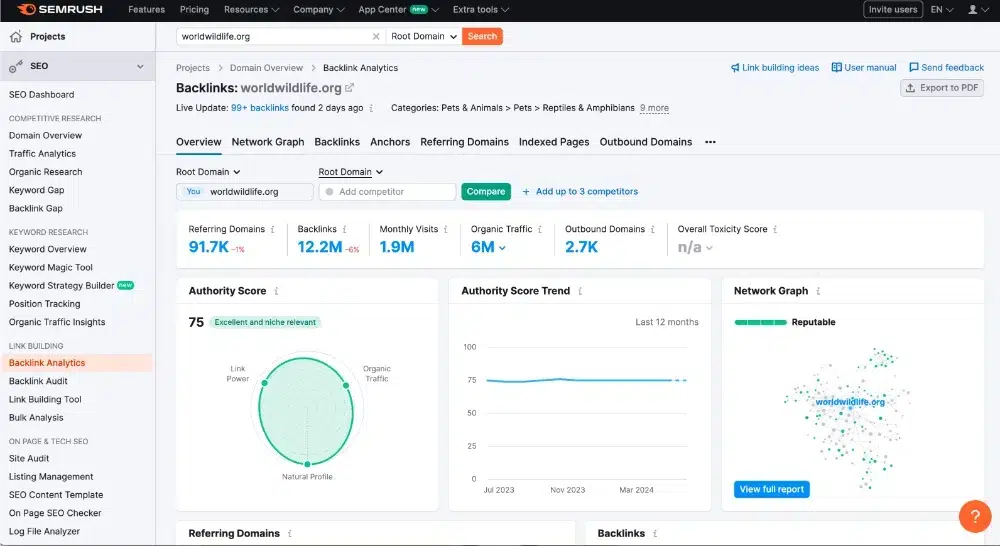
You can also consider Ahrefs to check your backlinks and website authority.
Broken Link Building
Broken link building is an effective and often underutilized SEO strategy that involves finding broken links on other websites and suggesting your own content as a replacement. This approach not only helps webmasters fix dead links on their sites but also allows you to gain valuable backlinks, improving your site’s authority and search engine rankings
How to Implement Broken Link Building
- Identify Relevant Websites: Use tools like Ahrefs, Semrush, or Moz to find websites in your niche that have strong authority and relevant content. These sites are prime candidates for broken link building.
- Find Broken Links: Utilize tools like Check My Links (a Chrome extension) or Dead Link Checker to scan these websites for broken links. These tools highlight broken links on a page, making it easy to spot opportunities.
- Create or Identify Relevant Content: Ensure you have high-quality content that matches the topic of the broken link. If you don’t have suitable content, create new, valuable content that can serve as a replacement.
- Reach Out to Webmasters: Craft a polite and informative email to the webmaster or site owner then follow up with them.
Journalist Request
Journalist requests are a powerful way to boost SEO by gaining high-quality backlinks and increasing brand visibility. Here are simple steps to follow:
- Sign Up for Services: Register with platforms like Connectively, SourceBottle, or ProfNet to receive daily journalist requests.
- Respond Promptly: Reply quickly to requests with clear, concise, and valuable information.
- Be Relevant: Ensure your response is highly relevant and provides unique insights or data.
- Follow Up: If needed, politely follow up with the journalist.
- Leverage Features: Share published features on your social media and website to maximize exposure.
- Track Mentions: Use tools like Google Alerts or Mention to monitor where your contributions are published and gain backlinks.
Content Marketing and SEO
Off-page SEO includes different strategies and one of the important ones is content marketing. While Creating high-quality content is a great way to earn backlinks, garner media attention, and showcase E-E-A-T, promoting this content through various channels can further strengthen off-page signals.
Here are some of the best methods to distribute the content you’ve created.
Guest Blogging and Posting
One effective technique for expanding your brand’s exposure is through guest blogging and guest posting. By contributing quality content to reputable sites in your niche, you can gain backlinks and tap into a broader audience.
It’s a mutual benefit where the host site receives valuable content, and you get increased visibility, driving traffic back to your site.
To find guest blogging opportunities, search on Google with search queries like the following:
- “your target keyword” + “guest column”
- “your target keyword” + “guest post”
- “your target keyword” + “contributing writer”
- “your target keyword” + “contributing author”
Contributing with Influencers
Partner with influencers in your field to boost your content’s reach. Influencers can share your content with their followers, providing you with a broader platform and instant authority.
Their endorsement can significantly augment your content marketing efforts by generating buzz around your brand and content, which in turn can lead to improved search rankings.
Contributing in Podcasts
Podcasts are immensely popular and offer a great way to gain a competitive advantage, as most businesses aren’t yet using them. They enable you to reach new audiences, share your expertise, and increase visibility, often resulting in valuable backlinks, which are a key part of off-page SEO.
Off-page SEO includes leveraging opportunities like being featured on podcasts, where hosts might link to your site or reference it in their descriptions, enhancing your online presence and SEO efforts.
Building Brand and Reputation
In the aspect of what Off page SEO include, Off-page SEO stays a powerful tool that extends beyond your website, focusing on increasing your brand’s reputation and awareness across the web. Your off-page efforts directly contribute to how your brand is perceived by potential customers and search engines alike.
Brand Mentions
Brand mentions, whether linked or unlinked, act as a signal to search engines that your brand is gaining popularity and relevance. You want to be mentioned across diverse platforms, ensuring your brand’s name becomes synonymous with your industry or niche. For search engines like Google, these mentions serve as an indication of your brand’s authority, thus contributing to your SEO performance.
Online Reviews and Ratings
Online reviews and ratings are pivotal for building trust and credibility. Encouraging your customers to leave positive feedback on review platforms can significantly affect your brand’s online reputation.
Good reviews boost brand trust, while also potentially improving your visibility and ranking on search engines. Remember that response to both positive and negative reviews is equally crucial as it showcases your commitment to customer service.
Here are a few tips for online reviews:
- Kindly ask all customers to leave reviews
- Build trust by responding to all reviews
- Don’t accept (or offer) money in exchange for reviews

Additional Strategies for Off-Page SEO
In enhancing your website’s SEO, beyond the usual link-building, you should also focus on engaging with communities and leveraging digital media relationships. Effective off-page SEO strategies are crucial for building your brand’s reputation and trustworthiness.
Forum Engagement and Outreach
Participating in forums related to your industry can significantly bolster your brand’s visibility and credibility. By providing valuable insights and answering questions on these platforms, you establish yourself as an authoritative figure within your niche. Remember:
- Identify and engage in forums where your target audience is active.
- Prioritize building relationships and offering genuine assistance rather than just self-promotion.
Reddit and Quora are the two main platforms you can utilise. But forums within your niche can be just as effective to boost your outreach and engagement.
Digital PR and Journalism
Digital PR involves creating and maintaining relationships with journalists and influencers to gain high-quality media coverage. This approach can improve your brand’s presence and authoritative standing online. Consider the following:
- Build a network of digital PR contacts relevant to your industry.
- Craft compelling stories that reflect your brand’s value proposition to entice coverage from reputable media outlets.
Here is some of the advantage of Digital PR :
- Increase brand awareness and branded searches
- Put your business in front of your target audience
- Drive referral traffic
- Show E-E-A-T
By employing these off-page SEO tactics, you can improve your online performance and forge a trustworthy and influential brand.
Understanding SEO Metrics and Performance
When you’re delving into off-page SEO and what it includes, your focus should be on metrics and performance indicators that reflect your website’s standing in the wide web. These metrics often translate into how well you’re doing in terms of visibility and user engagement.
Key Metrics:
- PageRank: An algorithm used by Google to rank web pages in their search engine results. While not the sole indicator, it provides insight into the importance of your webpage based on incoming links.
- Rankings: Your position on search engine result pages (SERPs) often dictates the volume of organic traffic you receive.
- Domain Authority: A score that predicts how well a website will rank on SERPs. Higher scores correspond with the ability to rank better.
Performance Indicators:
- Organic Traffic: The number of visitors coming to your site from search engines.
- Referral Traffic: Visitors who come to your site from direct links on other websites are an integral part of off-page SEO.
- Conversions: The actions users take on your site that align with your business goals, such as making a purchase or subscribing to a newsletter.
Tools You Can Use:
- Google Analytics: For monitoring traffic and conversion rates.
- SEMrush or Ahrefs: To track rankings and domain authority, among other features.
Effective monitoring of these areas allows you to measure your SEO performance accurately. By using available tools, you can gauge the success of your off-page SEO efforts and adjust your strategies to improve your site’s search engine ranking. Keep in mind, achieving a high PageRank and boosting your rankings will likely lead to an increase in organic traffic, which can then lead to higher conversions.
Technical Considerations for Off-Page SEO
When leveraging Off-Page SEO strategies, it’s essential to understand the technical nuances that can significantly impact your website’s ability to earn and benefit from backlinks. These technical considerations influence how search engines view the relationships between your site and others.
The Role of NoFollow and DoFollow Links
When other websites link to yours, search engines scrutinize the nature of these links. DoFollow links convey trust and pass on “link juice,” which can boost your site’s authority. Conversely, NoFollow links tell search engines to disregard the link in terms of passing on authority, as they were introduced to combat spam and over-optimization. However, NoFollow links are still important for a natural link profile and can drive traffic to your site.
- DoFollow Links: Help in improving your link profile and can enhance your chances of ranking higher in search engine result pages.
- NoFollow Links: While they don’t contribute directly to your site’s ranking, they diversify your link profile and can lead to indirect SEO benefits, such as increased traffic.
The Impact of Site Structure on Off-Page SEO
Your site structure has a critical role in both crawling and indexing, essential steps before any off-page element come into play. A well-organized site with clear internal linking promotes more efficient site crawling by search engines, making your content easily discoverable.
- Clear Navigation: Helps search engines understand your website’s hierarchy, leading to better crawling and indexing of your linking pages.
- Internal Linking: Strategic internal links can distribute page authority throughout your site, which may improve the ranking potential of individual pages.
Through diligent attention to how to do technical SEO and careful construction of your site’s structure, you optimize the groundwork upon which successful Off-Page SEO is built. This foundation ensures that efforts to acquire high-quality backlinks, which off-page SEO includes, can translate into tangible SEO performance improvements for your site.
Frequently Asked Questions
Off-page SEO is crucial for your website’s success in search engine rankings as it represents the tactics used outside your website to impact your rankings within search engine results pages (SERPs).
How does off-page SEO differ from on-page SEO and why is it important?
Off-page SEO involves actions taken outside of your website to impact rankings, such as link building and social media marketing, unlike on-page SEO that deals with elements on your site like content and meta tags. It’s important because it helps search engines understand what others think about your site and content.
What are the latest off-page SEO strategies to enhance website visibility in 2023?
In 2023, effective off-page SEO strategies include influencer outreach, content marketing, and building a presence on social media platforms as these can lead to significant increases in mentions, shares, and valuable backlinks for enhanced visibility.
Can you list the essential off-page SEO tools for effective digital marketing?
Essential off-page SEO tools include backlink analyzers, brand mention tools, and influencer outreach platforms. Tools like Ahrefs and BuzzSumo can help monitor your site’s backlink profile and brand mentions, which are key to your digital marketing efforts.
Which techniques and practices are considered advanced for off-page SEO?
Advanced off-page SEO techniques comprise creating shareable infographics, guest blogging on reputable sites, and engaging in strategic link building activities. These practices require a deeper understanding of SEO trends and market behavior.
Why is understanding off-page SEO crucial for beginners in digital marketing?
For beginners in digital marketing, understanding off-page SEO is essential as it complements on-page efforts and helps search engines see your site as authoritative and relevant, making your content more likely to be placed higher in search results.
What role does backlink quality play in off-page SEO?
The quality of backlinks is more important than quantity in off-page SEO. High-quality, relevant backlinks from reputable websites signal to search engines that your content is valuable and trustworthy, which can positively affect your SERP rankings.
Conclusion
Understanding what does off page SEO includes is vital for any comprehensive digital marketing strategy. It encompasses a range of activities beyond your website, such as acquiring high-quality backlinks, engaging in social media marketing, and influencer collaborations, all aimed at boosting your online visibility and brand reputation. These efforts, when effectively executed, can significantly enhance your site’s authority and search engine rankings, proving that off-page SEO is as crucial as on-page optimization in your journey to SEO success.
Consistency and patience are key to steadily climbing to the top of Google’s search results.
What other off-page SEO practices do you believe are essential for boosting organic search rankings?
Need a Digital Solution?
Get in contact now with Experts!
We answer calls 24/7!


